
On this page
Garage door dent repair starts with a question that has nothing to do with looks: does the door still travel properly? A dent that has creased the steel, shifted a hinge line or pushed a roller toward the edge of its track is a structural fault on a door that weighs more than a fridge and hangs off springs under serious tension. This guide covers how to tell a cosmetic dent from that, what genuinely reduces a dent in a steel panel, why a roller curtain is different, and when a panel or a whole door is the answer.
First: is the door safe to run?
Do these checks before you press the remote
- Sight along the panel from the side. A dent within the flat face is cosmetic; a fold or sharp line across it is a crease.
- Check both vertical tracks for bends, dents or a gap where they have pulled off the wall.
- Look at every roller on the damaged side; each should sit fully inside the track, not tilted or partly out.
- Check the hinges on the dented panel for torn screws or bent plates, and the bottom cables for slack.
- If everything passes, pull the manual release and lift the door a few centimetres by hand. It should move smoothly and stay put. Grinding, catching or a door that wants to drop means stop.
Do not run a door with a creased panel or a bent track
Powering a door through a crease or a damaged track can tear the panel off its hinges or drop the door in the opening. If any check fails, leave the door where it is, keep people and cars out of the doorway, and have it looked at. The springs and cables are under tension at all times and are never a DIY item.
Dents in a sectional panel: what you can fix
A sectional panel is a thin steel skin, often over a foam core, formed into ribs or raised rectangles. The flat areas between the profile lines are where a dent can be worked. The profile lines give the panel its stiffness, and a dent that lands on one, or has creased through the skin, has changed the shape of the steel for good: filler can hide it, but nothing pushes it back. The method below suits a rounded dent no bigger than a dinner plate in a flat area you can get behind. Work gently and stop early.
- Wash the area and mark the edge of the dent with masking tape so you can see how far it moves.
- Warm the panel with a heat gun on low or a hair dryer, kept moving, until the steel is warm but not hot. Never use a naked flame on a foam-cored panel.
- From behind, hold a flat softwood block against the deepest point and tap it with a rubber mallet, working from the outer edge inward. Small taps, many of them.
- If you cannot get behind the panel, seat a suction-cup puller on the warmed face and pull straight out with steady pressure.
- Check with a straight edge across the panel and stop pushing once the dent is within a millimetre or two of flat.
- Skim what remains with a thin layer of flexible automotive filler, sand flush, spot-prime and paint. Thick filler on a flexing panel cracks out.
A filled patch never quite disappears on a factory finish, especially a metallic or textured colour. If the door faces the street, read our guide to painting a garage door before you reach for the filler, because a repair on one panel can turn into a repaint of the whole door.
Dents and creases in a roller door curtain
A roller door is one continuous corrugated sheet, and the corrugations are the only thing giving it stiffness. A dent that flattens a few of them, or a crease across them, changes how that section coils on the drum: the damaged part stands proud on the roll and each cycle works the crease further. A curtain cannot be repaired one section at a time: hammering the corrugations back leaves a wavy patch that catches worse than the dent did. Minor cosmetic dents in a curtain that still rolls cleanly are best left alone. Anything that binds in the guides needs the curtain assessed for replacement, and a catching door should never be forced, because the spring inside the drum does not forgive a jam.
When a dent stops the door working
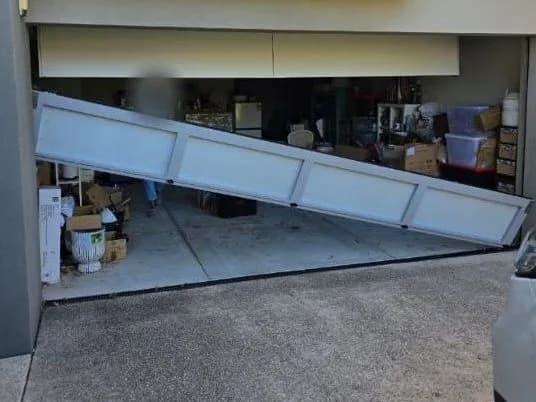
The dent itself is rarely what stops a door; what stops it is what the impact did around it. A sectional panel that has folded even slightly no longer holds its rollers square, and a roller that is not square binds as it enters the curved track at the top of the opening. That is how a dent turns into a door that has come out of its tracks, a more urgent problem. On a roller door, the curtain stops at the height where the dented section will not feed into the guides. Either way the fix is to stop running the door, and to book a repair for a door that has stopped running properly rather than trying to free it.
Single panel replacement or a new door?
Sectional doors are built from separate panels joined by hinges, and that is the good news: a creased, rusted or badly dented panel can usually be swapped on its own while the rest of the door, the tracks and the opener stay put. The honest caveat is matching. A panel has to match the profile, height, skin texture and colour of its neighbours. On a door a few years old from a current range, a matched single panel replacement is straightforward. On an older door the exact profile or colour may no longer be made, and the choice becomes a near-match panel that shows in some light, or a new door. We tell you which once we have the maker, the model and a photo, rather than promising a match we cannot confirm.
- One panel damaged, door under about ten years old, range still current: replace the panel.
- Colour or profile discontinued: a near-match panel if you can live with it, otherwise a new door.
- An old, noisy door that is now dented: a new sectional door with fresh hardware may cost less over the next decade than patching this one.
Car-bump damage: the bottom panel and the track
Most of the dented doors we see around Mandurah were hit by the car that lives behind them: reversing before the door was fully up, or nosing into a closed door. Reversing into a partly open door catches the bottom panel from underneath, folding the panel, bending the track and often tearing a roller out. Either way, the checks at the top of this guide matter more than the dent, and if the door was moving when it was hit, the opener's travel limits and safety reverse will need re-testing once the panel and track are sorted.
The repair order is track first, then panel, then balance, then opener limits and safety reverse, with the door secured so the springs cannot move it. The price is agreed before any work starts, and photos from inside and outside the garage are the quickest way to a straight answer.