
On this page
Ask most people what lifts their garage door and they'll say the motor. It isn't. A typical opener pulls with about the strength of one adult arm — the real lifting is done by garage door springs storing and releasing energy on every cycle, with the motor doing little more than steering. That's why one failed spring stops a perfectly healthy opener dead, and why understanding springs is understanding the whole door.
What garage door springs actually do
A double sectional door commonly weighs somewhere between 80 and 150kg. The springs counterbalance that weight so closely that a healthy door, disconnected from its motor, lifts with one hand and floats wherever you leave it. Every open-and-close cycle winds and unwinds the steel, and steel that flexes eventually fatigues. That's the whole story of spring failure: not abuse, not bad luck, just metal reaching the end of its counted cycles.
The one-hand balance test
With the door fully closed, pull the opener's manual release and lift the door by hand. A balanced door rises smoothly with light effort and stays put at half height. A door that fights you, drops, or won't budge has a spring problem — lower it gently, reconnect the opener and stop using the door.
Torsion vs extension springs (and roller doors)
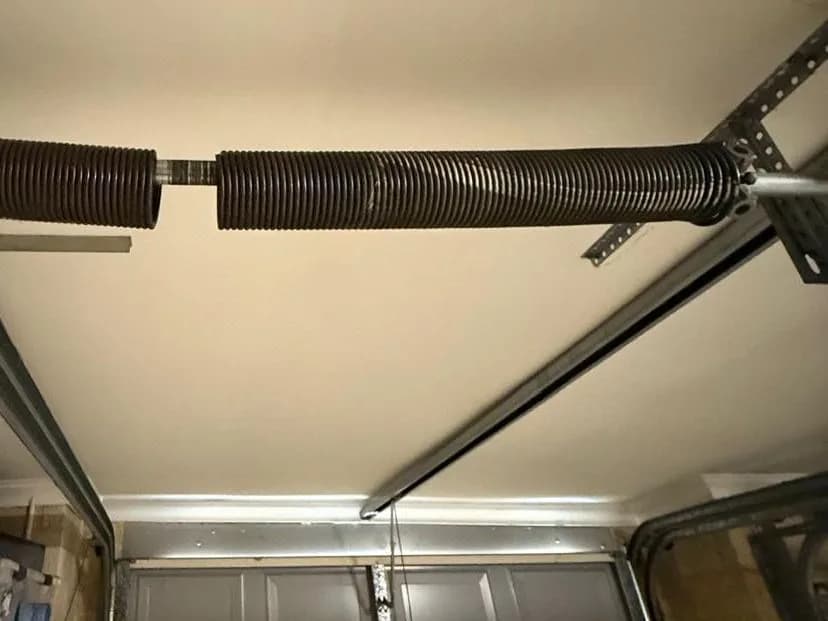
Garage doors run one of three spring systems. A torsion spring garage door has one or two coils on a steel shaft above the opening that twist to store energy — nearly every modern sectional door in Australia uses them, they lift evenly, and they're the ones that fail with a bang. Extension springs stretch along the horizontal tracks on older and lighter doors. Roller doors are different again: their spring sits inside the axle drum the curtain wraps around, which is why a roller door with a tired spring feels heavy at the bottom of its travel.
- Torsion: above the opening, twists on a shaft — modern sectional doors, smoothest lift, loudest failure
- Extension: along the tracks, stretches — older and lighter doors, and they should always carry a safety cable
- Roller-door springs: inside the drum — failure shows as a heavy curtain that won't stay up
- Tilt-door springs: large coil or cone springs at the sides of the frame — they hold a one-piece door under serious load
Extension springs need safety cables
An extension spring that snaps without a safety cable threaded through it can whip across the garage. If your older door has bare extension springs, having safety cables fitted is a small job that removes a real hazard — ask for it at the next service.
Which spring does my door need?
Springs are matched to the door, not picked from a shelf. The right torsion spring depends on the door's weight and height, the drum size, and then the spring's own wire thickness, inside diameter, length and wind direction (left or right hand). Get one of those wrong and the door either creeps up on its own, drops like a stone, or the opener strains on every cycle. Roller-door and tilt-door springs are just as specific to the make and size of door.
That's the catch with the loose springs sold online: the listing gives a size, but not whether it suits your door, and working it out properly means weighing the door and measuring the old spring while it's safely unwound. A technician sizes it on site, fits it with proper winding bars and balances the door before anything is signed off. Our garage door spring repair service covers torsion, extension, roller and tilt doors across Mandurah.
How long springs last — and why less in Mandurah
Springs are rated in cycles, not years. Standard residential springs are commonly built for around 10,000 cycles; a household using the door four to six times a day gets through that in seven to ten years. Two things shorten it. Salt carried off the ocean and the estuary pits spring steel, and a pitted coil concentrates stress exactly where fatigue cracks start. Poor balance does the rest: a door that runs crooked or binds on worn rollers and hinges loads one spring harder than its twin and spends its cycles early.
What stretches spring life
- A regular service that re-tensions and re-balances the door
- Corrosion-protected springs on a door near the water — ask for them at replacement
- A light garage door lubricant on the coils once or twice a year
- Fixing crooked or binding travel promptly rather than living with it
- Longer-life (higher-cycle) springs if the garage is your main way in and out
How often a door should be looked at depends on how hard it works and how exposed it is — the garage door servicing interval guide goes through it door by door.
How do I know if a garage door spring is going?
- The door feels heavier on a manual lift than it used to
- It drops the last half-metre instead of settling
- It rises crooked, one corner leading
- The springs groan, creak or pop as the door starts moving
- Rust on the coils, or a gap opening between coils that used to sit tight
Any one of those is a booking, not an observation. A re-tension or a planned replacement is calmer and cheaper than the same job done as an emergency with the car trapped inside.
What to do when a garage door spring breaks
The failure itself is hard to miss: one bang from the garage, loud enough that neighbours ask about it. Look above the door and you'll usually see a clean gap in the coil. From that moment the door is dead weight. The opener will strain and give up or, worse, drag the door partway and let it drop. Don't run the motor, don't pull the manual release while the door is raised, and don't try to lift a double door with a broken spring by hand — it can weigh over 100kg with nothing helping you and nothing to hold it up. The broken spring or cable checklist covers what is safe to check while you wait.
If the car is trapped inside
Say so when you call. Raising a door with a broken spring safely to free a car is routine for a technician and risky for anyone else. Most repairs are finished the day they are booked. We carry the common spring sizes on the van, so most spring failures are fixed in a single visit.
Is it worth fixing a garage door spring?
Almost always. A broken spring doesn't mean the door is finished — springs are a wearing part, like tyres, and replacing them brings a sound door straight back to full use. The exceptions are doors where the panels, tracks and cables are also worn out, or an old one-piece tilt door whose frame has rusted through; then the spring money is better put towards a new door, and a technician should show you why rather than just say so. When one spring of a pair breaks, replace both: they've done the same number of cycles and the survivor is close behind.
What sets the price of garage door spring replacement
Spring work is quoted per door, and what moves the number is plain enough: how many springs the door runs, their size and cycle rating, whether it's a single or a matched pair, how easy the shaft is to reach, and whether you need us in standard hours or after them. If the springs are sound but the door has simply lost tension, a re-tension needs no new parts at all. The price is confirmed before any work starts. Mismatched old-and-new springs pull the door subtly crooked, which wears the lift cables and rollers faster — another reason pairs are replaced together.
Can I replace garage door springs myself?
No, and this is the one garage door repair where we say it flatly. A wound torsion spring on a double door holds a large amount of energy. Letting that tension off or winding it back on is done with purpose-made winding bars in a set sequence, holding the bar against a force that will spin it violently if grip or footing slips. The injuries from shortcut attempts are to hands, wrists and faces, usually from someone who watched a video and used a screwdriver instead of a proper bar. Replacing the springs yourself also skips the balancing that stops the new springs wearing out early.