
On this page
Every automatic garage door has a way to open it manually, because everyone needs it eventually: a blackout during a storm, a failed motor on a work morning, a remote that died in a pocket. Used correctly it takes ten seconds. Used on the wrong door — one with a broken spring — it can drop the full weight of the door without warning. This guide covers both halves: the easy part, and the judgement call that keeps it safe.
What the garage door manual release actually does
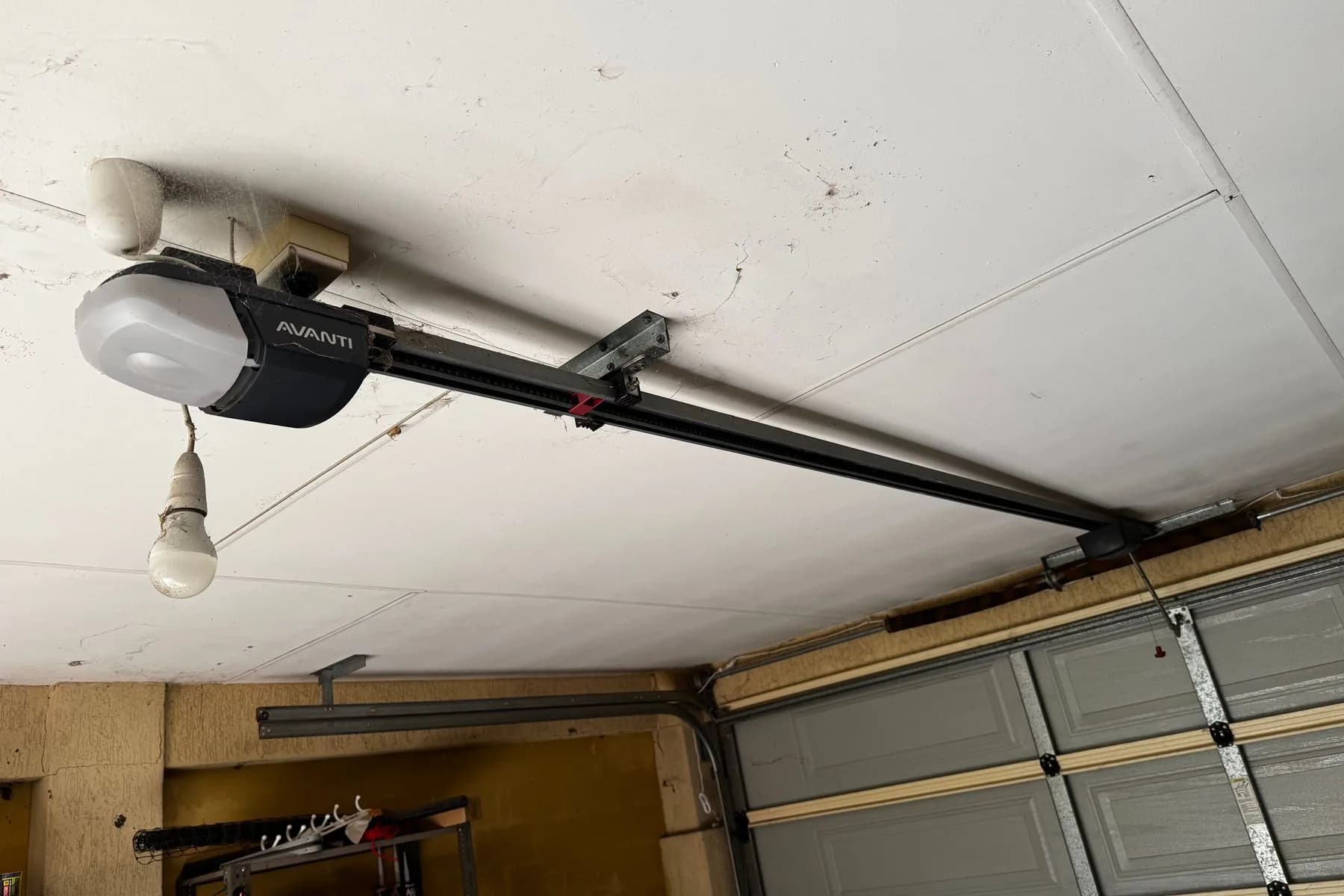
Look up at the rail running from the motor to the door and you'll find a red cord, usually with a handle, hanging from a small carriage called the trolley. The trolley is what connects the door to the motor's drive. Pulling the cord unhooks that connection — nothing more. The door is then free to move by hand, riding on its springs exactly as it always does. The motor isn't damaged, nothing is reset, and the springs keep doing the lifting. That's the whole safety story: manual mode is only as safe as the springs are healthy.
How to open a garage door manually with no power
- Check the door is fully CLOSED before you pull anything — this matters more than any other step
- Pull the red cord straight down until you feel or hear the trolley release
- Lift the door evenly with both hands from the handle or the bottom edge — it should feel light
- Raise it fully and make sure it stays up on its own before you walk or drive under it
- Close it by hand the same way, all the way to the floor, and lock it if it has a manual lock — a released door isn't secured
The weight test is the safety test
A balanced door lifts with light effort from one or two hands. If it takes real strength, stops rising, or wants to drop back down, the springs are not carrying it — lower it gently, step away, and treat it as a broken spring. Never prop it and work underneath.
Getting back out of manual mode
This is the question everyone asks the next day: the power is back but the remote does nothing, because the trolley is still disconnected. On most Australian openers there are two ways to re-engage: pull the red cord back toward the door to re-arm the latch, or simply press the remote and the motor drives the trolley forward to hook onto the door by itself. Run one full open-close cycle afterwards. If the trolley won't catch, slide the door by hand until the two line up. If the opener itself is still acting up after the outage, the opener and remote reset guide covers the power cycle and the other resets.
How to open a garage door from outside
If the garage is your only way in and the power fails while you're outside, the options narrow. Some doors have an external key release — a small round lock on the door face whose key pulls the release cable from outside. If yours doesn't, and there's no other door into the garage, don't try to force the door or fish for the release cord: anything you can slip past the seal, a burglar can too. That's a call-out, and we take after-hours emergency call-outs for exactly this. Our emergency garage door repairs page explains how that works. Afterwards, have an external key release fitted, and keep one way into the house that doesn't depend on the garage.
When NOT to pull the manual release
- The door is stuck OPEN or part-way — releasing the trolley on a raised door lets it fall if the springs are weak
- You heard a loud bang beforehand — that's a broken spring, and the door is unsupported weight
- The door is visibly crooked or a cable is hanging loose — the lift system has failed on one side
- The door jammed mid-travel under power — something mechanical is wrong, and forcing it adds damage
Each of those follows the same rule: the manual release assumes the springs and cables are healthy. When they aren't, the motor was the only thing holding the door, and the red cord hands its weight to gravity. Leave it where it is and book a broken spring replacement. The garage door won't open checklist helps you tell a dead opener from a broken spring before you touch the cord.
Opening a roller door manually
Roller doors don't have a rail and trolley. Their motor sits beside the drum the curtain wraps around, and the manual override is usually a release cord, lever or knob on the motor itself — some models use a clutch you disengage. Once released, a healthy roller door lifts by the bottom rail with light effort, because the spring inside the drum is doing the work. A curtain that's heavy at the bottom of its travel has a tired drum spring: stop and book rather than muscling it. The roller door motors guide shows how the common units are laid out.
Can someone else open your garage door?
Not with their own remote, on a modern rolling-code opener — rolling codes mean each remote has to be paired at your motor. The realistic risks are simpler: a lost remote that still works, an old fixed-code opener, or a release cord that can be hooked through the top of the door. Clearing the opener's memory when a remote goes missing, and a manual lock for when you're away, deal with most of it; the garage door locks guide covers the options.
A door that opens by itself in the middle of the night is almost always one of three things: a remote being pressed in a pocket, bag or car nearby, a faulty wall button or its wiring, or a failing control board. Unplug the opener overnight if it happens again, then have it checked — a door opening unprompted is a security problem, not just an odd one.