
On this page
Most of the noise a sectional door makes comes from ten or twelve small wheels nobody looks at. Each panel has a roller at both ends: a steel stem in a hinge, a wheel in the track. When they wear, the whole door sounds like it is failing while the motor, springs and cables are fine. Here is how rollers work, how to tell they are done, what to buy, and where the DIY line sits. Around Mandurah that matters more than most places, because salt off the ocean and the estuary gets through roller bearings before anything else on the door.
What garage door rollers actually do
A roller is a wheel on a stem. The stem slides into a sleeve on a hinge, or on the top and bottom brackets, and the wheel rides inside the C-shaped track on the wall and ceiling. Rollers do not lift the door; the springs and cables do that. Their job is to keep a door weighing over a hundred kilos aligned and gliding as it turns the curve from vertical to horizontal. Once a wheel's bearings seize it skids instead of turning, and every cycle grinds a flat into the wheel and a groove into the track.
Roller doors have no wheels: the curtain winds onto a drum, and nylon or felt strips in the guides do the sliding. If a roller door has gone stiff or loud, the noisy garage door checklist covers guides, spring and curtain separately. Everything below is about sectional doors.
Five signs your rollers are worn
- Grinding, rumbling or a squeal that changes pitch as the door moves, loudest through the curve of the track.
- The door shudders or jerks partway up, then settles, instead of running smoothly end to end.
- A wheel that is chipped, cracked or worn oval, or a nylon tyre split away from its bearing.
- A stem sitting at an angle in its hinge, or a hinge sleeve worn so wide the stem rattles in it.
- The door hangs crooked at the top corners, or one side runs ahead of the other as it opens.
Act on that last one quickly. When a roller lets go completely the panel can twist out of the track on that side, and a door that has come off its track is a far bigger repair than the roller that caused it. If the door already looks skewed, stop using the motor.
Nylon vs steel rollers: which to choose
Steel rollers are what most builders fit: cheap, strong and loud, with open bearings that load up with grit and moisture until they seize. Nylon rollers put a nylon wheel on a sealed ball-bearing race: noticeably quieter, no rust, and the seal keeps sand and salt out. For a door on a bedroom wall, or one that runs before six in the morning, nylon is the sensible upgrade; pick a sealed bearing with a solid stem, because hollow-stem bargain packs bend. Steel still suits very heavy timber or glass doors and commercial doors running dozens of cycles a day, where a nylon wheel can deform under load. For a standard home door near the water in Mandurah, corrosion decides it: canal and beachfront homes wear through unsealed steel rollers years before inland homes do.
Are all garage door rollers the same?
No, and the wrong size is the most common way a DIY roller swap goes sideways. Australian residential doors mostly run a wheel of roughly 45 to 50 millimetres in a track about 50 millimetres wide; commercial doors use a larger wheel in a wider track. Stem length varies too: too short and it pulls out of the hinge under load, too long and it binds on the track. Pull one middle roller, measure the wheel and the stem, and match both. Hinges are numbered as well, and the numbers climb up the door because each higher hinge offsets its roller further out to follow the track's taper. Keep every hinge and roller in its own position.
Replacing rollers: what is DIY and what is not
The middle and top rollers can be swapped by a confident owner, because those hinges are not holding any lifting force. The two bottom rollers are different, and that difference is the whole safety story of this job.
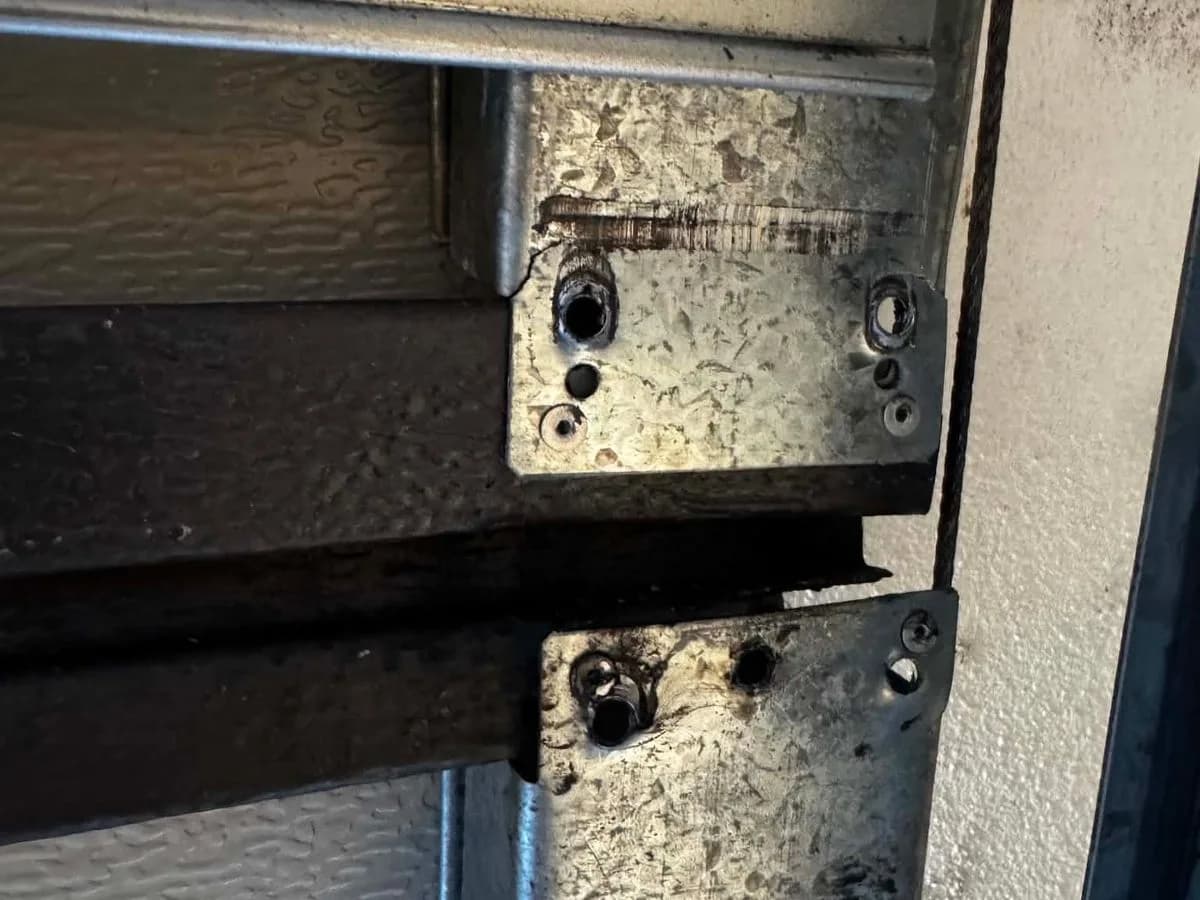
Never unbolt the bottom roller brackets
The bracket at each bottom corner of a sectional door anchors the lifting cable, and that cable carries the full tension of the torsion spring. Undo those bolts and the bracket can fire off the door hard enough to break bones, and the cable can whip. Bottom rollers are changed with the tension held or wound down, which needs the right bars and the right training. Leave those two to a tradesman, every time.
- Close the door fully, unplug the motor and pull the manual release so nothing can drive the door while you work.
- Start with a middle hinge. Undo the bolts on one side of the panel joint only, so the other hinges keep holding the panel.
- Tilt the freed edge of the hinge away from the door until the old stem slides out of its sleeve, then slide the new roller in.
- Check the wheel sits square in the track and bolt the hinge back down firmly. Never leave two hinges on one joint loose together.
- For the top rollers, mark where the adjustable bracket sits before loosening it, and return it to the same mark.
- Reconnect the release, run the door by hand through its full travel, then under power, and listen for any new bind through the curve.
If that is more than you want to take on, every roller, hinge and track fixing is checked as part of a garage door service, and worn rollers are swapped during that visit. The common sizes travel with us, so a roller job rarely waits on parts. Most repairs are finished the day they are booked.
Can you spray WD-40 on garage door rollers?
Not as a lubricant. WD-40 is a water-displacing solvent; on a roller it thins out whatever grease was in the bearing and leaves a film that collects sand. Use it to clean a rusty stem before fitting a new roller, and nothing else. For lubrication use a silicone spray or a white lithium grease made for garage doors, on the bearing and stem rather than the wheel face, and keep the track dry, because grease in the track turns grit into a paste that wears the wheels. A light spray on every roller, hinge pivot and the spring twice a year is the whole routine; the garage door servicing schedule guide covers the rest of the list.
Track and hinges: the parts that wear with the rollers
New rollers in a damaged track are noisy again within weeks. Sight along each vertical track for dents, look at the curve for a flattened section, and check the track brackets are tight to the wall. A small dent can be straightened; a kinked track is replaced. Hinges wear where the stem turns in the sleeve, and a wallowed-out sleeve sets a fresh roller crooked from day one. Bottom hinges and floor-level fixings also corrode from the inside out where salt and sand sit against them, which is why roller and hinge replacement on the older homes along the water around Mandurah tends to come as a set. If the door has jammed or dropped on one side, that is beyond a service: book a repair for a door that is not running right and describe what you can see.